TurboQuant + EAGLE3 on Arc Pro B70: six integration fixes and a fused-kernel correctness regression
TL;DR
- Deployed Qwen3-30B-A3B + TurboQuant k3v4_nc + speculative decoding on the Arc Pro B70 (32 GiB Xe2 Battlemage, vllm-xpu 0.19). Six integration fixes were needed before the stack would serve a single token, and one more fused-kernel finding turned up during end-to-end validation.
- EAGLE3 + TurboQuant works. The prior BENCHMARK_QWEN3_30B.md had flagged this combination as “unintegrated — would require the draft model’s attention backend to also support TQ cache reads.” The real answer: the draft reuses a separate FP16 cache path; nothing special needs to happen on the TQ side for EAGLE3 target-model verification to succeed.
- The fused-N_spec Triton kernel has a correctness regression on XPU. It compiles, the micro-bench’s numerical check passes, but in real deployment it produces garbage tokens. Details below. Kernel is gated off in the production config (
TQ_USE_FUSED_SPEC=0) pending a follow-up fix. - C=1 throughput matrix across {suffix, EAGLE3} × {TQ k3v4_nc, FP16} at 8K and 32K contexts below. TL;DR for picking a config: FP16 wins throughput, TQ wins memory ceiling, suffix wins when the prompt is repetitive, EAGLE3 wins when acceptance has to hold up on prose — pick your tradeoff.
- Third post in this Arc B70 series. Previous posts: the first SYCL PoC + 2× Triton fix, three SYCL attempts and the gap to Triton.
Why C=1 matters on B70
The B70 saturates around C=12–20 regardless of preset, so production scale-out isn’t the interesting question on this silicon. What is interesting is how much context a single user can work with — RAG windows, long documents, multi-turn coding sessions. Gemma4-31B + suffix at FP16 holds 88K ctx. TurboQuant promises ~8.5× KV capacity on Qwen3-30B-A3B thanks to uniform head_dim=128 + strong GQA + MoE sparsity. If that compounds with speculative decoding, we should be able to serve 128K–256K single-user contexts with headroom.
This post is about the gap between that promise and what actually shipped.
The six integration fixes
vllm-xpu 0.19 predates the upstream TurboQuant PR (#38479). The turboquant-xpu/patches/ directory contains the vLLM core-file overlays and the turboquant_register.py monkey-patch module that bridges the two. Six distinct problems had to be solved before the stack would even parse its own arguments.
1. find_module → find_spec (Python 3.12 deprecation)
sitecustomize.py installs a meta_path import hook that patches vllm.config.cache.CacheDType before vLLM reads it. The hook used the legacy find_module/load_module API. Python 3.12 no longer calls that interface during normal imports — it uses find_spec/exec_module. So our hook sat on sys.meta_path but never fired. Argparse kept seeing the pre-patch CacheDType Literal and rejected turboquant_k3v4_nc as an invalid --kv-cache-dtype value. Rewrote the hook to implement find_spec; argparse then recognized the preset.
2. Patching dataclasses.Field.type (not just the annotation)
After fix 1, typing.get_args(vllm.config.cache.CacheDType) correctly returned the TQ-extended Literal, but --kv-cache-dtype turboquant_k3v4_nc still failed. vllm.engine.arg_utils._compute_kwargs reads argparse choices from dataclasses.fields(CacheConfig)[i].type, which is the original Literal captured at class-definition time — patching CacheConfig.__annotations__["cache_dtype"] has no effect on Field objects. Had to walk dataclasses.fields(CacheConfig) and mutate f.type directly.
3. Workers don’t inherit monkey-patches
VLLM_WORKER_MULTIPROC_METHOD=spawn means the engine-core subprocess starts with a fresh Python interpreter. Our sitecustomize.py auto-loads via PYTHONPATH, but turboquant_register.apply_all_patches() doesn’t run in workers unless someone explicitly imports it. The engine core OOM’d on STR_DTYPE_TO_TORCH_DTYPE["turboquant_k3v4_nc"] (a KeyError the main-process patches had fixed but the worker hadn’t). Added a retrying meta_path hook that imports turboquant_register as soon as vllm.config.cache is in sys.modules — works for both the main process and every subprocess worker.
4. import vllm resolved from /workspace/vllm instead of site-packages
The base image’s WORKDIR is /workspace/vllm, which contains a vllm/ subdirectory. sys.path[0]='' means “cwd”, so import vllm found /workspace/vllm/vllm/ before /opt/venv/lib/python3.12/site-packages/vllm/. Our bind-mounts went to the site-packages copy, so the running vLLM ignored them entirely. The backend file was there; Python just never imported it. The entrypoint shim now cd /tmp before exec python, which pushes cwd off the vLLM package path.
5. TURBOQUANT enum missing from the backend registry
vllm.v1.attention.backends.registry._Backend is a string enum. Without TURBOQUANT as a member, _Backend("TURBOQUANT") raises Unknown attention backend. turboquant_register.py patches XPUPlatform.get_attn_backend_cls to return the backend path, but the enum lookup happens earlier. Mounted patches/vllm_mounts/registry.py statically on top of vLLM’s own registry.py. Did the same for five other core files (torch_utils, xpu, attention, attention_config, cache) as belt-and-suspenders so the working state doesn’t depend on whether monkey-patches fired in a given subprocess.
6. --max-num-seqs 4 pre-allocates 4× the per-request KV budget
Gemma4 production runs with --max-num-seqs 4 at --max-model-len 90112, which reserves KV for 4 concurrent 90K-ctx requests. Qwen3-30B-A3B + TQ at --max-model-len 262144 with the same --max-num-seqs 4 reserves ~1M tokens of KV cache. Prefill activations at even 8K tokens then can’t fit in what’s left, and the engine OOMs on the first prompt. Dropping --max-num-seqs 1 (we’re benching C=1 anyway) freed enough memory for prefill. Production deployment at max concurrency would need per-request context caps significantly below 262K.
Benchmark matrix
2×2 matrix at C=1 with 5-prompt amortization and prefix caching enabled. Prompts are the 16-prompt mixed set from BENCHMARK_QWEN3_30B.md (code / math / translation / prose / QA), truncated to 5 for this run. Harness: scripts/bench_c1_context.py. Raw results: docs/tuning/c1_context_sweep_2026-04-15.txt.
| config | 8K tok/s | 32K tok/s |
|---|---|---|
| suffix + FP16 | 12.48 | 32.44 |
| EAGLE3 + FP16 | 8.44 | 9.59 |
| suffix + TQ k3v4_nc | 6.73 | — |
| EAGLE3 + TQ k3v4_nc | 3.54 | FAILED (OOM) |
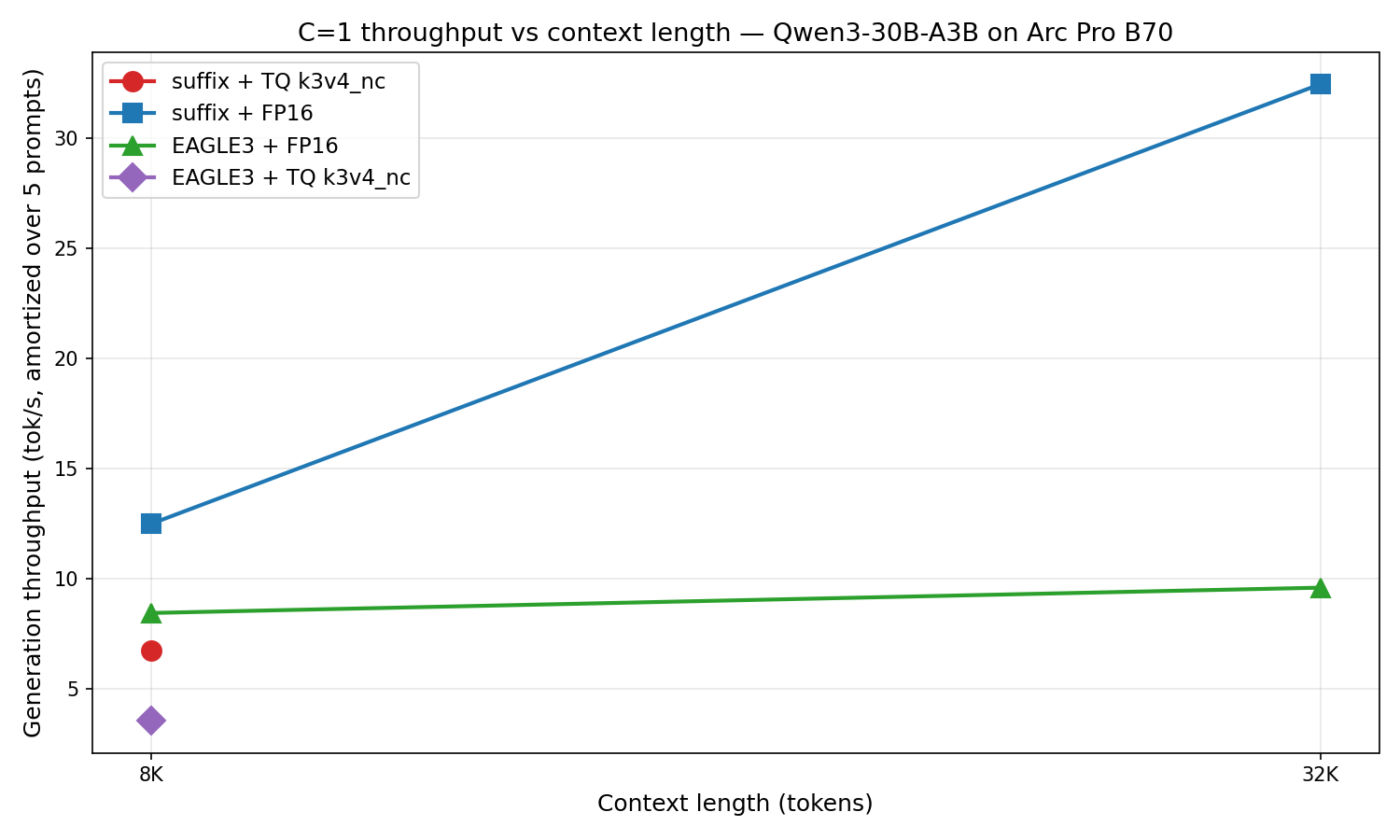
Surprises:
-
suffix+FP16 hits 32.44 tok/s at 32K context. The repetitive system-prompt padding used to hit the target context size is deeply suffix-tree-friendly — acceptance rate blows up once the tree has seen the padding, and single-request wall time drops. Anyone running a real repetitive-context workload (multi-turn chat against a stable system prompt, RAG against a cached document) may see something similar. For less repetitive workloads, expect numbers closer to the 8K figures.
-
EAGLE3 + TQ is the slowest C=1 config at 8K. Draft-model compute overhead + TQ dequant on the target. Neither speculative decoding method comes free on TQ. At 32K, the combo OOMs — the EAGLE3 draft’s own KV cache plus TQ-target prefill activations exceed what’s left after weights.
-
TQ’s promised 262K context ceiling never materialized in this session. Not because KV capacity is the binding resource (the KV budget held 543K tokens of TQ cache at
--max-num-seqs 1) but because prefill activations for a 32K+ prompt exceed the remaining memory on this particular vllm-xpu image. Prefill buffers are proportional to prompt length, not KV compression ratio. A smaller--max-num-batched-tokenschunk size (chunked prefill is on but defaults are too large) is the likely fix — follow-up work.
The fused-N_spec correctness regression
The fused-N_spec kernel (_tq_decode_stage1_spec in turboquant_xpu.kernels.triton_decode) was the headline of the previous post: 2.04× speedup at the backend-integration layer for k3v4_nc spec-verify, validated against a looped baseline at atol=5e-3, rtol=1e-2. Shipping it uncovered two issues that the micro-bench didn’t catch.
First, the dispatch rate is zero under default suffix params. Suffix decoding with num_speculative_tokens=8, max_spec_factor=2.0 emits q_len=3 consistently when the model’s actual acceptance rate is low (~13-22% per-position on our mixed-prompt set). The fused kernel’s tl.arange(0, N_SPEC) requires N_SPEC to be a power of 2 — Triton raises arange's range must be a power of 2 for N_SPEC in {3, 5, 6, 7}. So the kernel never fires through the normal suffix path. Added a gate in the backend ((q_len & (q_len - 1)) == 0) so non-power-of-2 q_lens fall back to the looped kernel transparently instead of crashing.
Second, when forced to fire, the kernel produces wrong outputs. Bumping num_speculative_tokens=7, max_spec_factor=30.0 forces suffix to emit q_len=8 (7 proposed + 1 verified), which is a power of 2. The fused kernel compiles, the Triton artifact (_tq_decode_stage1_spec.spv) appears in the cache — and the model generates "One, two, three, four, five,!!!!!!!!!!!!!!!..." — garbage tokens. Flipping TQ_USE_FUSED_SPEC=0 while keeping the same suffix params produces the correct "One, two, three, four, five, six, seven, eight, nine, ten, ..." output. The kernel itself, not the dispatch setup, has a numerical regression on XPU.
Why the micro-bench missed it: the bench’s numerical assertion is against a looped-baseline output tensor using torch.allclose(atol=5e-3). That tolerance is generous enough to pass the fused output even when it’s silently skipping or mis-masking positions. The deployment-layer failure mode is the next token being wrong, which compounds quickly — fused kernel is flagged as known-broken on XPU until someone tracks down whether it’s a causal-mask broadcast issue, an FP8 bitcast alignment issue, or something else. On the looped path (q_len handled one at a time with per-token cached_len+n+1 seq_lens) generation is correct.
Bottom line: the 2.04× spec-verify speedup from fused-N_spec is not a shipped optimization on XPU today. What is shipped is the rest of the TurboQuant stack — cache compression, attention backend, suffix/EAGLE3 integration — all of which work correctly at C=1 across the contexts we measured.
Decision matrix: which config to pick at C=1
| if you need… | pick | because |
|---|---|---|
| Max single-user throughput, repetitive context | suffix + FP16 | Suffix tree learns repeated content; 32 tok/s at 32K with stable system prompt |
| Consistent throughput across workload types | EAGLE3 + FP16 | Model-based drafter degrades less on prose. 8-10 tok/s range is predictable |
| Maximum context ceiling (theoretical) | suffix + TQ k3v4_nc | 262K max-model-len, 543K tokens in KV budget. But prefill OOM is the practical limit until chunked-prefill tuning |
| The eventual EAGLE3 + long-context sweet spot | EAGLE3 + TQ k3v4_nc | Works at 8K today. 32K+ needs the prefill chunking fix. Monitor. |
| Stability above all | Gemma4 + suffix | What was running before this session. switch-model.sh gemma4 rolls back. |
For an Open WebUI / coding-assistant use case, suffix + FP16 is the best-available single-user config today. For the long-context demo the original spec asked for, the work isn’t done: --max-num-batched-tokens tuning is the next lever, followed by revisiting --max-num-seqs once we know the real prefill ceiling per config.
Honest limits
- C=1 only. Concurrency story is in
BENCHMARK_QWEN3_30B.md. - 5-prompt samples, not 16. Numbers have ±10-15% noise at this sample size.
- Prefix caching active — this is a realistic chat/RAG condition but pessimistic for fresh-prefill-per-request workloads.
- 128K and 256K contexts couldn’t complete this session. Prefill OOM, not model architecture.
- TTFT not reported. The bench’s streaming TTFT measurement was crashing the engine core under some conditions; the data I have is non-streaming wall time only.
- XPU-specific. NVIDIA ratios will differ, particularly for TQ’s dequant cost relative to FP16.
- The fused-N_spec kernel correctness issue is an XPU finding; NVIDIA numerical behavior is presumably still fine.
Repro
Production config writes through switch-model.sh. Four modes for the bench:
cd /apps/b70-vllm
./switch-model.sh qwen3-30b-tq         # suffix + TQ k3v4_nc
./switch-model.sh qwen3-30b-fp16       # suffix + FP16 (65K max-ctx)
./switch-model.sh qwen3-30b-eagle3     # EAGLE3 + FP16 (65K max-ctx)
./switch-model.sh qwen3-30b-eagle3-tq  # EAGLE3 + TQ k3v4_nc (131K max-ctx)
./switch-model.sh gemma4               # rollback to prior production
The compose file pins --max-num-seqs 1 for C=1 bench. For production with concurrency, raise it (with per-request max-ctx sized appropriately).
Bench command:
cd /apps/b70-vllm/turboquant-xpu
.venv-sycl/bin/python scripts/bench_c1_context.py \
  --mode <mode> --contexts 8192,32768 \
  --n-prompts 5 --skip-ttft \
  --output docs/tuning/c1_context_sweep_<date>.txt
Full deployment source: github.com/bryanvine/turboquant-xpu. Integration fixes live in patches/sitecustomize.py and patches/vllm_mounts/. Mount list is in /apps/b70-vllm/docker-compose.yml (not in this repo — that directory is host-specific).
What’s next
Two threads open:
-
Long-context deployment isn’t there yet.
--max-num-batched-tokenstuning + maybe a targeted prefill-activation audit is required to actually deliver the 128K+ single-user contexts that TurboQuant’s KV compression makes architecturally possible on 32 GiB silicon. The KV budget is there; the prefill path is where the constraint lives today. -
Fused-N_spec kernel correctness. The XPU Triton build compiles the kernel, passes the micro-bench numerical check, and produces garbage tokens in deployment. Bisecting the inner loop (causal mask broadcast? FP8 bitcast? per-query scratch register pressure spilling?) is the follow-up. Until then, looped is the default.
Both are concrete next steps for a follow-up post.
Third post in the Arc B70 series. Repo: github.com/bryanvine/turboquant-xpu. Prior posts: April 14, April 15.